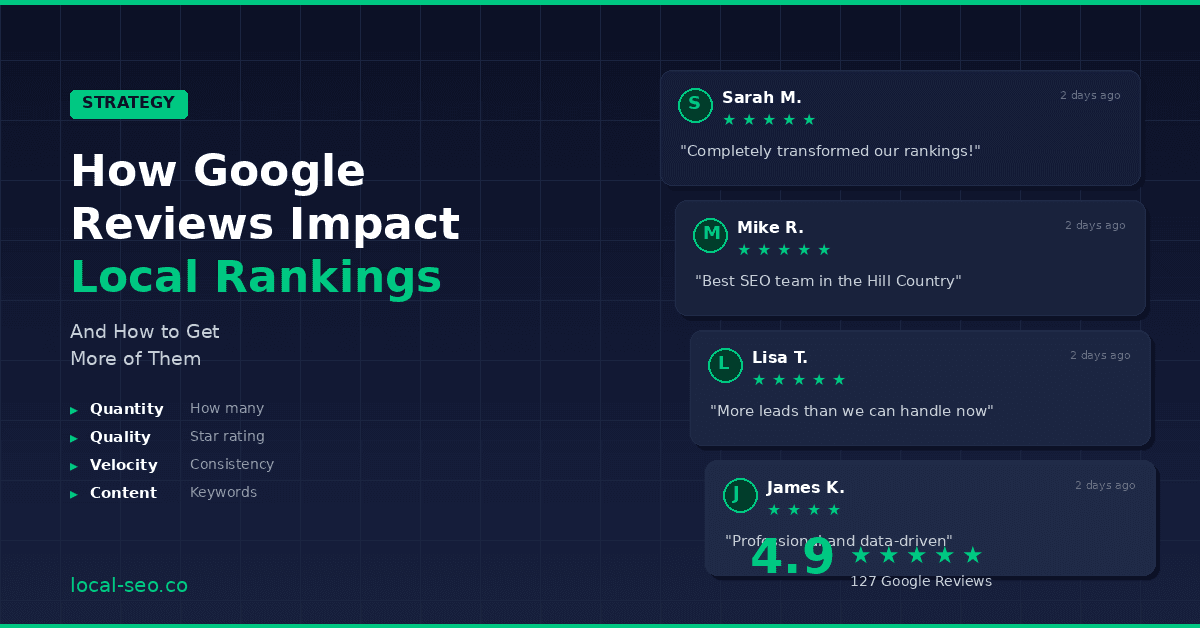
How Google Reviews Impact Local Rankings (And How to Get More of Them)
Every local business owner knows that Google reviews matter. Customers read them before making decisions, and a string of one-star reviews can sink a business faster than almost any other factor. What fewer business owners understand is just how directly reviews influence whether their business appears in Google's Map Pack at all.
Reviews aren't just social proof for potential customers. They're a core ranking signal that Google's algorithm uses to determine which businesses deserve the top three local spots. A business with strong review metrics — quantity, quality, velocity, and relevance — has a measurable advantage over competitors with weak review profiles, even if those competitors have better websites or more backlinks.
This guide explains exactly how Google uses reviews in its local ranking algorithm, gives you a practical system for generating more reviews consistently, and shows you how to respond to reviews in a way that reinforces your local SEO signals.
How Google's Algorithm Uses Reviews for Local Rankings
Google has confirmed that reviews are a factor in local search rankings. Based on extensive industry testing and correlation studies, we know that reviews influence local rankings through several specific mechanisms.
Review Quantity
The total number of Google reviews your business has is a ranking signal. Businesses with more reviews generally rank higher than businesses with fewer reviews, all else being equal.
This doesn't mean the business with the most reviews always wins — proximity and relevance still matter. But in a competitive market where multiple businesses are similar in terms of location and services, review count often serves as the tiebreaker.
The threshold varies by industry and market. A restaurant in a busy urban area might need 200+ reviews to be competitive, while a specialized B2B service provider might only need 30-50. The benchmark is your direct competitors — look at the review counts of the businesses currently ranking in the Map Pack for your target keywords and aim to match or exceed them.
Review Quality (Star Rating)
Your average star rating is both a ranking factor and a click-through rate factor. Google tends to favor businesses with higher ratings, and users are far more likely to click on a 4.7-star business than a 3.8-star business.
The sweet spot for star ratings is 4.2 to 4.9. Interestingly, a perfect 5.0 rating can sometimes work against you — consumers may perceive it as suspicious or assume the reviews are fake. A rating in the 4.5-4.8 range signals high quality while still appearing authentic.
If your rating has dropped below 4.0, prioritizing review quality improvement through better service delivery and targeted review generation from satisfied customers should be your top priority before focusing on quantity.
Review Velocity (Recency and Frequency)
Google doesn't just look at how many reviews you have — it looks at how recently you've received them and how consistently they arrive. A business that received 100 reviews three years ago but hasn't gotten one in six months sends a weaker signal than a business with 60 reviews that gets 3-5 new ones every month.
Review velocity tells Google that your business is active, that customers are engaging with you, and that the quality indicated by your ratings is current and ongoing. A sudden stop in reviews can signal that something has changed — maybe you've closed, maybe quality has declined, or maybe the reviews were artificially generated and Google's systems caught on.
The goal is a steady, consistent stream of reviews. Spikes followed by dry periods look unnatural. Aim for a predictable cadence — even 2-3 reviews per month is sufficient for most small businesses.
Review Content and Keywords
The actual text content of your reviews matters more than many business owners realize. When a customer writes "Best emergency plumber in Boerne — they fixed our burst pipe at midnight and the price was fair," that review contains location keywords (Boerne), service keywords (emergency plumber, burst pipe), and positive sentiment signals that Google's natural language processing can parse and use for ranking purposes.
Google has explicitly stated that it considers review content when determining local rankings. Reviews that mention specific services, locations, and positive experiences reinforce the relevance signals that your Google Business Profile and website are sending.
You can't control what customers write in their reviews (and you shouldn't try to script them — Google detects and penalizes obviously prompted language). But you can influence the topics they mention by providing excellent service in specific areas and by asking for reviews at moments when specific aspects of your service are top of mind.
Review Responses
Your responses to reviews are also indexed by Google and contribute to your local SEO signals. When you respond to a review and naturally include relevant keywords and location references, you're adding additional content to your Google Business Profile that Google can use for ranking purposes.
Beyond the SEO benefit, businesses that respond to reviews see higher engagement rates, more reviews overall, and better click-through rates from their Map Pack listings. Users see that a business is active and engaged, which builds trust.
Building a Review Generation System
Knowing that reviews matter is one thing. Building a system that consistently generates them is another. The businesses with the strongest review profiles don't leave it to chance — they have a process.
The Fundamental Principle: Make It Easy and Make It Habitual
Most satisfied customers are willing to leave a review. They just don't think about it, don't know how, or don't want to spend time figuring it out. Your system needs to solve all three problems.
Remove friction. Create a direct link to your Google review form. In your Google Business Profile dashboard, you'll find a "Share review form" option that generates a short URL. When a customer clicks this link, they go straight to the review writing interface — no searching for your business, no navigating through Google Maps. That single-click experience dramatically increases conversion rates.
Shorten this URL using a service like Bitly or a custom short domain for branding purposes. Something like "review.local-seo.co" or a simple Bitly link is easier to share across channels.
Make it top of mind. Integrate the review request into your existing customer touchpoints rather than creating a separate outreach process. The ask should feel like a natural part of your customer interaction, not a marketing campaign.
Channel-Specific Review Request Strategies
In-person (at point of service). For businesses with face-to-face customer interactions, the most effective review request happens at the moment of peak satisfaction. When a customer expresses gratitude, compliments your work, or visibly shows satisfaction — that's your window.
A simple script works: "I'm really glad we could help. If you have 30 seconds, a Google review would mean the world to us — it's how other people in [city] find us." Hand them a business card with a QR code that links directly to your review form.
Text message (after service). For service businesses, sending a text message within 1-2 hours of job completion catches customers while the experience is fresh. Keep the message short and personal.
Example: "Hi [Name], this is [Your Name] from [Business]. Thanks for choosing us today! If you were happy with the work, we'd really appreciate a quick Google review — it helps other [City] folks find us. Here's the link: [URL]"
Text messages have significantly higher open rates than email (98% vs 20%), making this one of the highest-converting review request channels.
Email (follow-up sequence). For businesses with longer customer relationships or higher-ticket services, an email follow-up 24-48 hours after service works well. Include the review link prominently, keep the email short, and make the ask clear.
Don't bury the review request in a long newsletter or satisfaction survey. A dedicated, short email with a single purpose — asking for a review — performs best.
At checkout or on receipts. Retail businesses and restaurants can add a QR code to receipts, table tents, counter displays, or checkout screens. The QR code should link directly to the Google review form. Include a brief message: "Enjoyed your visit? Tell us on Google."
On your website. Add a "Leave Us a Review" button or section on your website, particularly on thank-you pages, confirmation pages, and contact pages. After someone has completed a transaction or inquiry through your website, prompt them to share their experience.
Timing and Frequency
The single most important factor in review generation is timing. Ask when the customer is happiest — immediately after a positive interaction, a successful project completion, or an expressed compliment.
Never batch review requests. Sending 50 review request emails on the first of every month looks unnatural and can trigger Google's spam detection. Instead, integrate the ask into your workflow so requests go out organically as customers are served.
For businesses that serve multiple customers per day (restaurants, retail, salons), aim for a steady daily trickle of review requests rather than periodic blasts. For businesses with fewer, larger engagements (contractors, consultants, medical practices), ask after each major milestone or project completion.
What NOT to Do
Don't offer incentives. Google's policies explicitly prohibit offering discounts, gifts, or any form of compensation in exchange for reviews. Violations can result in review removal and profile penalties.
Don't use review gating. Review gating means filtering customers before directing them to your Google review page — sending happy customers to Google and unhappy customers to a private feedback form. Google banned this practice and can penalize businesses that use it.
Don't ask only happy customers. While it's natural to want positive reviews, selectively asking only customers you know are satisfied is a form of review manipulation. Ask all customers and let your service quality determine the results.
Don't buy reviews. Purchased reviews are fake reviews, and Google's detection systems are increasingly sophisticated at identifying them. Getting caught results in review removal and potential profile suspension — a devastating penalty that can take months to recover from.
Don't use review kiosks or shared devices. Multiple reviews posted from the same device or IP address are flagged by Google's systems. Even if they're from real customers using a tablet at your front desk, Google may treat them as suspicious.
How to Respond to Every Review (With Examples)
Responding to reviews is a signal to both Google and potential customers that your business is active and cares about feedback. Here's how to do it effectively.
Responding to Positive Reviews
When a customer takes time to leave a positive review, your response should accomplish three things: express genuine gratitude, reference something specific about their experience, and subtly reinforce relevant keywords.
Generic (avoid this): "Thanks for the great review! We appreciate your business."
Better: "Thank you, [Name]! We're glad the kitchen renovation turned out exactly how you envisioned it. Working with homeowners in the Alamo Heights area is always a pleasure — the architecture there gives us so much to work with. We hope you enjoy the new space for years to come."
Notice how the better response includes the service (kitchen renovation), the location (Alamo Heights), and feels personal rather than templated. These natural keyword inclusions add to your profile's relevance signals.
Vary your responses. If every response follows the same template, it looks automated and loses both the human connection and the SEO value. Take 60 seconds to write something unique for each review.
Responding to Negative Reviews
Negative reviews are inevitable and, when handled well, can actually strengthen your reputation. Potential customers don't expect perfection — they want to see how you handle problems.
The framework for negative review responses:
-
Acknowledge promptly. Respond within 24 hours. A delayed response suggests you don't care.
-
Thank them for the feedback. Even if the review feels unfair, thanking the reviewer shows maturity and professionalism.
-
Apologize for their experience. You're not necessarily admitting fault — you're expressing regret that they had a negative experience with your business.
-
Don't argue or get defensive. This is the hardest part. Even if the customer is wrong, a public argument makes you look bad to every future customer who reads the exchange.
-
Take it offline. Provide a direct contact method (phone number or email) and invite them to discuss the issue privately. This shows willingness to resolve while preventing a public back-and-forth.
-
Keep it brief. Long, defensive responses draw more attention to the negative review. A concise, professional response is more effective.
Example response to a negative review:
"[Name], thank you for taking the time to share your feedback. We're sorry your experience didn't meet the standard we hold ourselves to. We'd like to understand what happened and make it right. Would you be willing to give us a call at [phone number] or email [email]? We take every customer's experience seriously and want to address your concerns directly."
Responding to Fake or Spam Reviews
If you receive a review that's clearly fake — from someone who was never a customer, contains defamatory content, or is obviously from a competitor — don't respond publicly with accusations. Instead, flag the review through Google's review reporting system and respond professionally.
Example: "We don't have any record of this transaction in our system. We'd love to look into this further — please contact us at [phone/email] with your order details so we can investigate."
This response tells other readers that the review may not be legitimate while maintaining professionalism.
Advanced Review Strategies
Leveraging Reviews for Content
Your positive reviews are a goldmine of customer-generated content. With permission, you can repurpose review quotes on your website, in social media posts, in email marketing, and on landing pages.
Reviews written in the customer's own words are often more persuasive than anything you could write yourself. A review that says "They completely transformed our backyard in just three days — our neighbors keep asking who did the work" is a testimonial you couldn't pay for.
Create a dedicated testimonials or reviews page on your website. Embed your Google reviews feed or manually curate the best reviews with attribution. This creates additional keyword-rich content on your site while providing social proof that drives conversions.
Review Monitoring and Alerts
Set up email notifications for new reviews through your Google Business Profile dashboard. This ensures you never miss a review and can respond quickly — within hours, not days.
For businesses managing multiple locations or monitoring competitors, tools like BrightLocal, ReviewTrackers, and GatherUp provide centralized review monitoring dashboards, automated alerts, and reporting.
Seasonal and Event-Based Review Pushes
Certain times of year naturally generate more customer interactions — and more review opportunities. Holiday seasons, annual events, end-of-project milestones, and post-purchase follow-ups are all optimal moments to emphasize your review generation process.
During high-traffic periods, ensure your review request system is running smoothly and consistently. The volume of customers passing through your business during peak season is an opportunity to rapidly build your review count.
Analyzing Competitor Reviews
Your competitors' reviews contain valuable intelligence. Read through the negative reviews of businesses ranking above you in the Map Pack. What are customers complaining about? Those complaints represent your opportunity to differentiate.
If a competing restaurant's negative reviews consistently mention slow service, make speed a core part of your value proposition. If a competing contractor's reviews mention poor communication, emphasize your communication process in your marketing. Turn your competitors' weaknesses into your strengths, and your own reviews will naturally reflect the difference.
Review Metrics to Track
Monitor these metrics monthly to gauge the health of your review profile:
Total review count — Your cumulative number of Google reviews. Track the growth rate over time.
Average star rating — Your overall rating. Flag any month where it drops below your target.
Review velocity — The number of new reviews received per month. Consistency matters more than volume.
Response rate — The percentage of reviews you've responded to. Target 100%.
Response time — How quickly you respond to new reviews. Target within 24 hours.
Keyword mentions — How often reviews mention your target services and locations. This is a proxy for the SEO value of your review content.
Competitor benchmarks — Compare your metrics against the businesses currently in the Map Pack for your target keywords. This tells you whether you're gaining or losing ground.
The Compounding Effect of Reviews
Reviews are one of the few marketing assets that compound over time. Every review you receive makes the next one more likely — businesses with more reviews attract more reviews because customers feel more confident engaging with a well-reviewed business. Every review makes your Map Pack ranking more secure. Every review adds content and keywords to your Google profile.
The businesses that start building their review profile today will have a significant, difficult-to-replicate advantage over competitors who wait. A business with 150 genuine, consistent reviews built over two years is nearly impossible to displace quickly. That kind of social proof and ranking signal takes time — and the sooner you start, the wider the gap between you and your competition.
Want help building a review generation system for your business? Contact Local SEO Co for a free review audit and custom strategy.