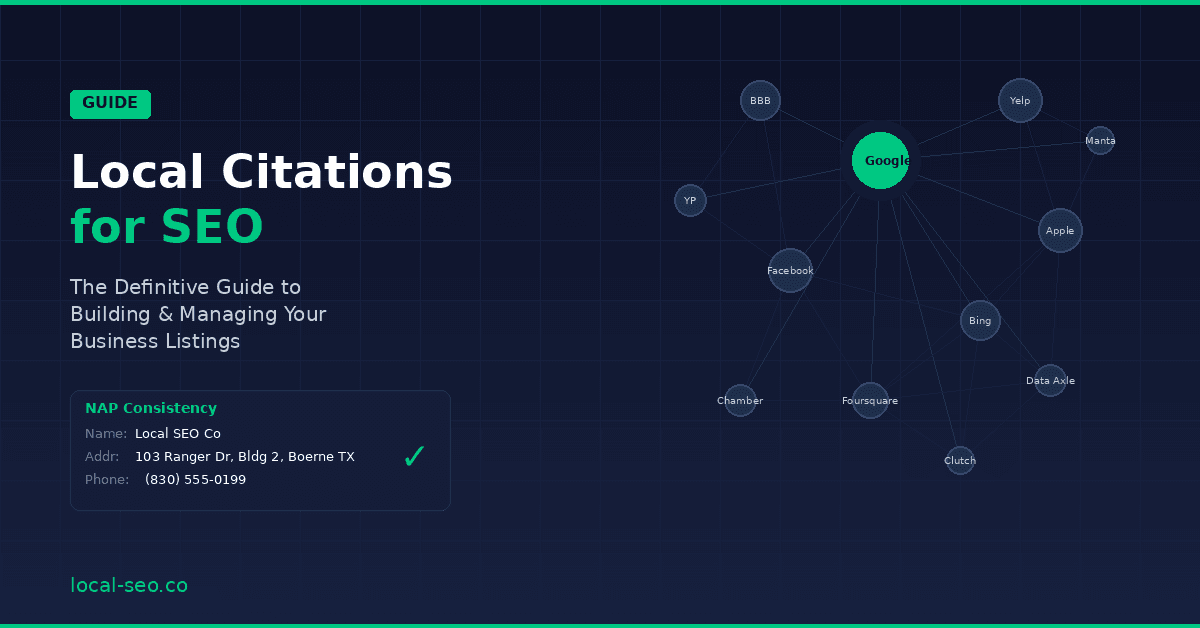
Local Citations for SEO: The Definitive Guide to Building, Managing, and Fixing Your Business Listings
If your business name, address, and phone number are listed differently across the internet, Google doesn't trust your data. And if Google doesn't trust your data, it won't put you in the Map Pack.
That's the core principle behind local citations, and it's one of the most misunderstood aspects of local SEO. Many business owners either ignore citations entirely or build them haphazardly — creating inconsistencies that actively hurt their local search rankings instead of helping them.
This guide covers everything: what citations are, why they matter, where to build them, how to audit what you already have, and how to fix the problems that are probably dragging your rankings down right now.
What Is a Local Citation?
A local citation is any online mention of your business's Name, Address, and Phone number — commonly referred to as NAP. Citations appear on business directories, social media platforms, websites, apps, and data aggregators.
Citations come in two forms:
Structured citations are formal business listings on directories and platforms — your Yelp page, your BBB listing, your Facebook Business Page, your Apple Maps entry. These have defined fields for your business name, address, phone number, website, and other details.
Unstructured citations are informal mentions of your business on websites, blogs, news articles, event pages, and other content. A local news article that mentions your business name and address is an unstructured citation. A chamber of commerce member directory listing is a structured one.
Both types send signals to Google that validate your business's existence and location. The more consistent and widespread these signals are, the more confidence Google has in your business data — and the more likely you are to rank well in local search.
Why Citations Matter for Local SEO Rankings
Google's local ranking algorithm relies on three primary factors: relevance, distance, and prominence. Citations directly influence prominence — how well-known and trustworthy Google considers your business to be.
Here's how that works in practice. When Google's crawlers and algorithms encounter your business information across the web, they cross-reference it. If your business name, address, and phone number are consistent across dozens of trusted sources — Google Business Profile, Yelp, BBB, Apple Maps, data aggregators, industry directories — Google gains confidence that your business information is accurate. That confidence translates into higher rankings.
Conversely, if Google finds inconsistencies — your address listed as "103 Ranger Dr" on one site and "103 Ranger Drive, Building 2" on another, or an old phone number on a directory you forgot about — those inconsistencies create doubt. Google doesn't know which version is correct, so it hedges by ranking you lower than competitors whose information is clean and consistent.
The impact of citation consistency has been validated in multiple industry studies. Businesses with consistent NAP information across a high number of quality citations consistently outrank businesses with fewer or inconsistent citations in the local Map Pack.
Citations also serve as a discovery mechanism. When your business is listed on popular directories, customers find you through those platforms in addition to Google. Yelp, Apple Maps, and Facebook all have their own search ecosystems with millions of users.
The Foundation: NAP Consistency
Before you build a single new citation, you need to establish your canonical NAP — the one correct version of your business name, address, and phone number that will be used everywhere.
This sounds simple, but it's where most businesses introduce problems. Here are the rules:
Business name: Use your exact legal business name. Not a variation, not a shortened version, not a keyword-stuffed version. If your business is "Local SEO Co," every citation should say "Local SEO Co" — not "Local SEO Company," not "LocalSEO Co," and definitely not "Local SEO Co — Best SEO Agency Texas."
Address: Choose one format and stick with it everywhere. Decide once whether you'll use "Street" or "St," "Suite" or "Ste," "Building" or "Bldg." Include suite or building numbers consistently. If your address is "103 Ranger Drive, Building 2, Boerne, TX 78006" — that exact string should appear on every single listing.
Phone number: Use a local phone number as your primary number. Toll-free numbers and call tracking numbers create inconsistency when used across citations. If you use call tracking, set your local number as the primary on all directories and use tracking numbers only where the platform explicitly supports a secondary number.
Website URL: Always use the same URL format. Decide between "https://local-seo.co" and "https://www.local-seo.co" and use that version everywhere. The trailing slash matters too — be consistent.
Write your canonical NAP down and save it somewhere your entire team can reference. Every time you create a new listing or update an existing one, use this exact format. No exceptions.
Where to Build Citations: The Priority List
Not all citations are created equal. A listing on Google Business Profile or Yelp carries far more weight than a listing on an obscure directory nobody uses. Focus your effort on the highest-value platforms first, then expand from there.
Tier 1: Essential Platforms (Do These First)
These are the platforms that directly feed data to Google, have high domain authority, and are used by a significant number of consumers.
Google Business Profile — The most important listing you'll ever create. If you've read our GBP optimization guide, you already know why.
Apple Maps (Apple Business Connect) — Apple Maps powers location data for every iPhone, iPad, Mac, and Apple Watch. With Apple holding roughly 55% of the U.S. smartphone market, this listing puts your business in front of the majority of mobile users. Claim it at businessconnect.apple.com.
Bing Places — Bing powers roughly 7% of U.S. searches, but more importantly, it feeds data to Cortana, Alexa, and many third-party apps. Claim it at bingplaces.com.
Yelp — Yelp has enormous domain authority and frequently appears in organic search results for local queries. A claimed Yelp profile with accurate NAP and positive reviews is a strong ranking signal.
Facebook Business Page — Even if you don't actively use Facebook for marketing, your business page is a high-authority citation. Ensure your NAP is accurate and matches your canonical format.
Better Business Bureau (BBB) — A BBB listing adds credibility and is a high-quality citation from a trusted domain. Accreditation isn't required — you can create a free listing.
Tier 2: Data Aggregators
Data aggregators are the companies that supply business information to hundreds of other directories, apps, and platforms. Getting your information right at the aggregator level cascades your correct NAP across the wider citation ecosystem.
Data Axle (formerly Infogroup) — One of the largest commercial data providers in the U.S. Data Axle feeds information to a vast network of directories and platforms.
Neustar Localeze — Another major data aggregator that distributes business information to search engines, directories, and navigation systems.
Foursquare — Foursquare's data powers location information for Apple Maps, Uber, Twitter, Samsung, and thousands of apps. Their business data reaches over 14 billion devices monthly.
Acxiom — A data aggregator focused on consumer data that feeds information to marketing platforms and directories.
Getting listed accurately on these four aggregators ensures your correct business information propagates to hundreds of secondary sources automatically. This is one of the highest-leverage citation building activities you can do.
Tier 3: Industry and Niche Directories
After the essential platforms and aggregators, focus on directories specific to your industry.
For a marketing or SEO agency, these include Clutch.co, UpCity, DesignRush, Expertise.com, and GoodFirms. For a restaurant, it would be TripAdvisor, OpenTable, Zomato, and Allmenus. For a healthcare provider, Healthgrades, Zocdoc, Vitals, and WebMD. For home services, Angi (Angie's List), HomeAdvisor, Thumbtack, and Houzz.
The key is to identify the directories that are authoritative in your specific industry and that consumers actually use when searching for your type of business. A listing on a relevant niche directory carries more weight than a listing on a generic directory that nobody visits.
Tier 4: General Directories
These are widely recognized business directories that provide solid citation value even though they're not industry-specific.
Yellow Pages (YP.com), Superpages, Manta, Hotfrog, CitySearch, and similar platforms have been around for years and maintain reasonable domain authority. They're worth listing on for citation breadth, but they shouldn't be your primary focus.
Tier 5: Local Directories
Local citations carry disproportionate weight for local SEO because they establish geographic relevance. These include your local chamber of commerce, city business directories, regional business associations, local news website business directories, and community organization sites.
If your chamber of commerce has a member directory with a link to your website, that's a high-quality local citation that many of your competitors won't have. The same goes for sponsorships of local events, membership in local business networks, and listings on local tourism or visitor bureau sites.
For Texas Hill Country businesses, relevant local citations include the Boerne, Kerrville, Fredericksburg, and San Antonio chambers of commerce, the Hill Country business networks, and regional tourism sites.
How to Build Citations the Right Way
Building citations is straightforward but requires attention to detail. Here's the process:
Step 1: Prepare your information. Before you start, have your canonical NAP, business description (short and long versions), category information, hours of operation, photos, and website URL ready. Having everything prepared prevents errors from rushing through forms.
Step 2: Start with Tier 1 platforms. Create or claim your listing on each essential platform. Complete every available field. Upload photos. Write unique descriptions for each platform — don't copy and paste the same description everywhere, as Google may view duplicate content negatively.
Step 3: Submit to data aggregators. Create your listings on Data Axle, Neustar Localeze, Foursquare, and Acxiom. These submissions take time to propagate — typically 4-8 weeks before your information starts appearing on secondary directories.
Step 4: Build niche and local citations. Work through your industry-specific directories and local directories. Prioritize quality over quantity — a listing on your local chamber of commerce is worth more than listings on ten obscure generic directories.
Step 5: Verify everything. After creating each listing, go back and verify that your NAP appears exactly as intended. Some platforms reformat addresses or truncate business names. Catch and fix these issues immediately.
A reasonable citation building timeline is 2-3 weeks for Tiers 1 and 2, followed by 2-3 weeks for Tiers 3-5. Don't rush the process. Accuracy matters more than speed.
How to Audit Your Existing Citations
If your business has been around for any length of time, you likely have citations scattered across the internet — some accurate, some outdated, some with errors you didn't know about. An audit identifies these issues so you can fix them.
Manual Audit Process
Search Google for your exact business name in quotes. Then search for your phone number. Then search for your address. Review the results and note every directory or website where your business appears. For each listing, check whether the business name, address, and phone number match your canonical NAP exactly.
Common issues you'll find include old addresses from a previous location, old phone numbers from a previous provider, variations in your business name (abbreviations, misspellings, outdated names), inconsistent address formatting, and duplicate listings on the same platform.
Using Audit Tools
Several tools can automate the audit process. Moz Local, BrightLocal, Whitespark, and Yext all offer citation audit features that scan the major directories and aggregators for your business information and flag inconsistencies.
These tools save significant time, but they're not perfect. They may miss smaller or niche directories, and they sometimes flag differences that aren't actually problems (like "TX" vs "Texas"). Use them as a starting point, then verify their findings manually.
What to Look for in an Audit
Exact NAP match: Is every element of your NAP identical to your canonical version? Even small differences matter. "St." vs. "Street," missing suite numbers, different phone number formats — all of these create inconsistency signals.
Duplicate listings: Having two listings for the same business on the same platform is a common problem, especially if your business has changed names, moved locations, or been claimed by multiple people. Duplicates confuse Google and split your review and citation equity.
Unauthorized changes: Some platforms allow users to suggest edits to business listings. Occasionally, competitors or random users submit incorrect information. Check that nobody has changed your hours, phone number, or other details without your knowledge.
Closed or inactive listings: If a directory has shut down or your listing is flagged as inactive, that's a dead citation providing no value. Note it and move on — you can't fix a listing on a platform that no longer exists.
How to Fix Citation Problems
Once your audit identifies inconsistencies, work through them systematically.
Claimed listings you control: Log in and update the information directly. This applies to Google Business Profile, Yelp, Facebook, BBB, and other platforms where you've claimed your listing.
Unclaimed listings: Many directories create business listings automatically from aggregator data, public records, or user submissions. For these, you'll typically need to claim the listing first (verify your ownership), then update the information. Most major directories have a claim process that involves phone or email verification.
Aggregator-sourced errors: If your information is wrong at the aggregator level (Data Axle, Localeze, Foursquare, Acxiom), fix it there first. Correcting the source prevents errors from propagating to downstream directories. Allow 4-8 weeks for corrections to cascade through the ecosystem.
Duplicate listings: For duplicate listings on the same platform, identify which listing has more reviews and engagement (the one you want to keep), then report the other as a duplicate through the platform's support channels. Google has a specific process for reporting duplicate GBP listings.
Listings you can't update: Some directories don't allow direct edits. In these cases, contact the directory's support team with your correct information and request an update. This can take time but is worth the effort for high-authority directories.
Prioritize fixes based on the authority of the platform. Fixing your NAP on Google, Yelp, and Apple Maps is far more impactful than chasing down an error on a low-traffic directory.
How Many Citations Do You Need?
There's no magic number, but there are benchmarks. Most local SEO studies suggest that the average business appearing in the Google Map Pack has between 80 and 150 citations. However, quality and consistency matter far more than raw quantity.
A business with 50 clean, consistent citations on high-authority platforms will outrank a business with 200 inconsistent citations on a mix of high and low-quality directories. The goal isn't to get listed on every directory that exists. It's to build a strong foundation on the most important platforms, ensure perfect consistency across all of them, and then expand strategically.
For most small businesses, here's a reasonable target: 6-8 Tier 1 platforms, 4 data aggregators, 8-12 niche and local directories, and 10-15 general directories. That gets you to 30-40 high-quality, consistent citations — which is enough to compete in most local markets.
If you're in a highly competitive market (like a major metro area), you may need to push toward 80-100+ citations. But again, consistency is the priority. One hundred inconsistent citations are worse than 40 consistent ones.
Ongoing Citation Management
Citation building isn't a one-time project. It requires ongoing maintenance for several reasons.
Information changes. If you change your phone number, move locations, update your hours, or rebrand your business, every citation needs to be updated. Failing to update old listings after a change is one of the most common causes of citation inconsistency.
Directories change. Directories merge, shut down, change their platforms, and occasionally reset their data. A listing you created correctly two years ago may have been altered or removed. Periodic audits catch these issues.
Competitors act. In competitive markets, some businesses (or their SEO agencies) submit incorrect information about competitors. While this is a violation of most platforms' terms of service, it happens. Regular monitoring protects you from unauthorized changes.
New directories emerge. New directories and platforms launch regularly. Staying current with relevant new citation opportunities keeps your profile competitive.
Schedule a citation audit every 6 months. Check your NAP consistency across Tier 1 and Tier 2 platforms, verify that no unauthorized changes have been made, and look for new citation opportunities. This maintenance takes a few hours but prevents ranking erosion from unchecked inconsistencies.
Citations and the Bigger Local SEO Picture
Citations don't exist in isolation. They're one component of a comprehensive local SEO strategy that includes Google Business Profile optimization, review management, on-page SEO, local content, and link building.
Think of citations as the foundation layer. They establish your business's existence, location, and legitimacy in Google's eyes. Without a solid citation foundation, your other local SEO efforts won't achieve their full potential. But citations alone aren't enough to dominate local search — you need the full stack working together.
The businesses that consistently win in local search are the ones that get the fundamentals right across all these areas. Clean citations, an optimized GBP, a steady stream of reviews, and quality local content — together, these signals compound to create a local search presence that's extremely difficult for competitors to displace.
Want a free citation audit for your business? Contact Local SEO Co and we'll identify every inconsistency in your current listings and build a plan to fix them.